Garmin Forerunner 265
The Forerunner 265 has a great feature set, including multi-band GPS support for accurate tracking, a bright AMOLED display and two weeks battery life on a full charge. Garmin Pay, notifications and offline music round off a full health and lifestyle feature list.
Garmin Forerunner 965
Garmin’s top-tier Forerunner offers all the company’s best fitness and lifestyle features. You’ll get lots of storage for music, plus preloaded maps, navigation and pro-level tracking for mountain biking and gold as standard. It’s the most expensive Forerunner for a reason.
Garmin Epix Gen 2
Garmin makes some of the best fitness wearables out there, and Prime Day makes the company’s new Epix Gen 2 the most affordable it’s been to date. This massive $250 discount won’t be around for long, so act now to get one today.
For 2023, Garmin updated itspopular running watcheswith AMOLED displays; ditching the muted transflective LCD panels and replacing them with brighter, more colourful, displays with high contrast levels. Both the Forerunner 265 andForerunner 965have been given the new display, but how do these two models compare, and could you save a little money and still get a high-quality experience on the cheaper model? We compare all the specs below.

Specs, pricing and availability
The Forerunner 265 and Forerunner 965 were announced in March 2023 and went on sale almost straight away. One of the good things about the Forerunner 265 series is that it doesn’t matter if you want the smaller ‘S’ or the regular model, it’ll cost you the same amount. It’s$449.99 in the USor£429.99 in the UKfor both sizes, and for all colour options. At that price, it’s also a good deal cheaper than the more fully-featured, longer-lasting Forerunner 965. That’s priced at$599.99 in the USor£599.99 in the UK, making it the flagship of the 2023 Forerunner range. The watches are now widely available.
Before we examine all the details of the device, we’re going to take a look at the specs so you may compare. Note that we’re including details of the 265S in the same listing as the 265 below.

One of the advantages of choosing the cheaper Forerunner 265 over the Forerunner 965 is the different sizes. Where the 965 only comes in one relatively large 47mm case size, the 265 has an ‘S’ model and - as is typicalfor Garmin- the ‘S’ stands for ‘Small’. It’s got a 42mm case (or 41.7mm), making it the smallest in this comparison, and much more suited to smaller wrists. It’s also the lightest. There is a 46mm Forerunner 265 as well, so you get two sizes to pick from when you go for the cheaper model, and there’s no increase in price between the smaller and regular-sized models. They’re the same watch internally/spec-wise, and so they cost the same amount.
The Forerunner 965 is the largest of the watches and is also the heaviest. None of the watches are burdensome though, all are made from a lightweight fibre-reinforced polymer case and ship with a light silicone strap. The 965 does have a bit of a premium touch in the design though; it has a titanium bezel surrounding the display area and features a harder Corning Gorilla Glass DX lens over the display. Both sizes of Forerunner 265 feature Gorilla Glass 3 on the display, which isn’t quite as durable or scratch resistant. All modelsare waterproof to 5ATM, making them perfectly equipped for outdoor activities in inclement weather or water-based sports.

As for colours, you essentially get a choice of three with each model. If you opt for the smallest Forerunner 265S you’re able to choose the Black and Amp Yellow version - which is predominantly black with a bright yellow accent on the strap - or a white model which features a white and Tropic (soft teal accent) strap and a black bezel, or light pink model with a black bezel and white-accented strap. The larger 265 has three different colours: White with a white and Tidal (almost royal) blue-accented strap and a black bezel, black with a black and Powder grey strap or Aqua model with a black-accented strap.
Lastly, the Forerunner 965, which has a black and grey model, a white and grey model or a bright Amp yellow model with black accents.
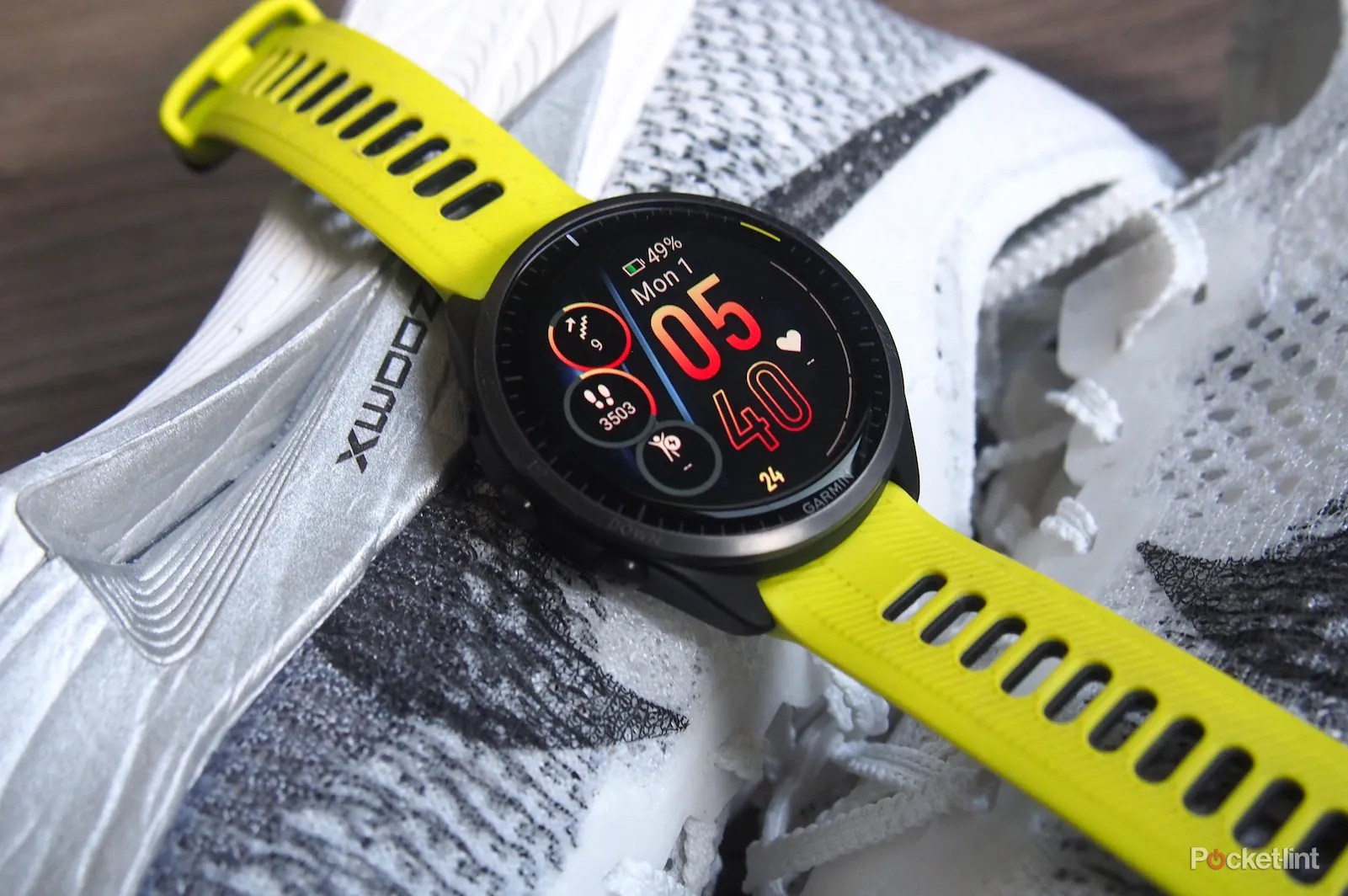
As you’d expect from three different-sized watches, all three feature different-sized displays as well. The smallest - the Forerunner 265S - has a 1.1-inch AMOLED display, whereas the larger 265 has a 1.3-inch panel and the Forerunner 965 features a 1.4-inch screen.
All three are round displays, and allthree are AMOLED, so should offer a virtually identical visual experience in terms of brightness, contrast and colour saturation. Even the sharpness should be near enough the same. The resolutions gradually increase with the sizes of display to ensure that the pixel density stays near enough the same regardless of which model you buy.

All three are touch-sensitive too, so you can scroll and tap on the glass to interact with the user interface, as well as use the usual five-button physical system when the touchscreen isn’t convenient (like during an activity).
The last thing worth noting on the displays is that all three models have an always-on option you can toggle on in the settings. Its default setting - being AMOLED - is for the display to turn off when it’s not been used for a 30-seconds or so. This helps save battery and gives it the 2 to 3-week battery life on offer. With always-on enabled, you’ll be able to see the time throughout the day, but the battery life will be significantly reduced, usually slashed in half.
Features and storage
There’s not much to separate the Forerunner 265 and Forerunner 965 on the lifestyle features side. Both will offer your smartphone notifications up on the screen, and give you quick replies to messages. You’ll also get calendar events served up, along with weather in your location, as long as you enable and give permission for those features.
You’ll get Garmin Payregardless of which watch you pick too, as well as offline music playback fromAmazon Music, Deezer and Spotify. However, if you imagine yourself loading lots of music to your wrist gadget, the Forerunner 965 will give you more of it. The more expensive watch comes with 32GB of storage versus just 8GB on the Forerunner 265.
Fitness tracking and health
When it comes to fitness, progress and all-day health tracking, both the Forerunner 965 and 265 offer all the key hardware and capabilities you’d expect. You’ll get multi-frequency location tracking on both models, and support for a number of different location tracking systems; GPS, Galileo and GLONASS are all catered for. That means it shouldn’t matter which watch you buy if what you’re after is accuracy when you’re tracking outdoor activities like running and hiking.
You’ll also get many of the same training and activity data points, plus useful features like Training Readiness, Recovery and Body Battery that help you to determine if you’ve rested enough since your last session to take on another. VO2 Max and SpO2 are measured and calculated, as are all-day heart rate, step counting, breathing, sleep and movement.
There are advantages to choosing the Forerunner 965 over the cheaper one, however. Its bigger storage means more room for additional features and data. It’s been loaded with maps, including road and trail maps and navigation to help you find your way around trail routes. It’s got a full suite of golfing features, including 42,000 golf courses preloaded, detailed mountain biking data like Grit and Flow measuring and more activities to track including kayaking, tennis, indoor climbing and bouldering among others. It’s a more fully-featured activity tracker. Runners get real-time stamina during the run and get insight into heat and altitude acclimation, so the Forerunner 965 is more advanced overall.
Battery life
How much battery life you get from a Garmin watch very much depends on how you use the watch and whether you have the always-on display enabled. In its default mode, with the screen switching off when not in use, you can get up to 23 days of regular smartwatch usage from the Forerunner 965. The smaller Forerunner 265S will give you up to 15 days, while the larger 265 with the bigger screen gives you 13 days.
This same tiered performance is seen in fitness and activity tracking too. The Forerunner 965 can track a GPS activity for up to 31 hours on a full battery. The smaller Forerunner 265S can do 24 hours and the larger 265 can manage 20 hours. It’s safe to say then that - of the three - the regular Forerunner 265 is the worst performing, but even that gives you a solid amount of time on a full battery.
It is worth noting that these GPS activity stats are based on the basic GPS setting, with the multi-band feature disabled, and with no music playing. If you switch on the multi-band tracking for improved accuracy and also listen to music on your watch while out on your run/hike/bike ride, the battery life will be reduced.
Conclusion
For most people, the Forerunner 265 (in either size) should offer you all the fitness, health and smart features you require and does so at a cheaper price than the Forerunner 965. It’s missing out on a few things and doesn’t have as big a battery, but its colourful, sporty designs will be appealing to some as well the fact that it comes in a small or regular size.
The Forerunner 965 is a more fully-featured watch, offering lots of additional features and activity data that some enthusiasts would miss out on on the smaller watch. If you want navigation and maps, or proper golfing or mountain-biking support, the 965 is the one to go for. It’s got a more premium design and is more expensive, but it offers a huge feature set.
